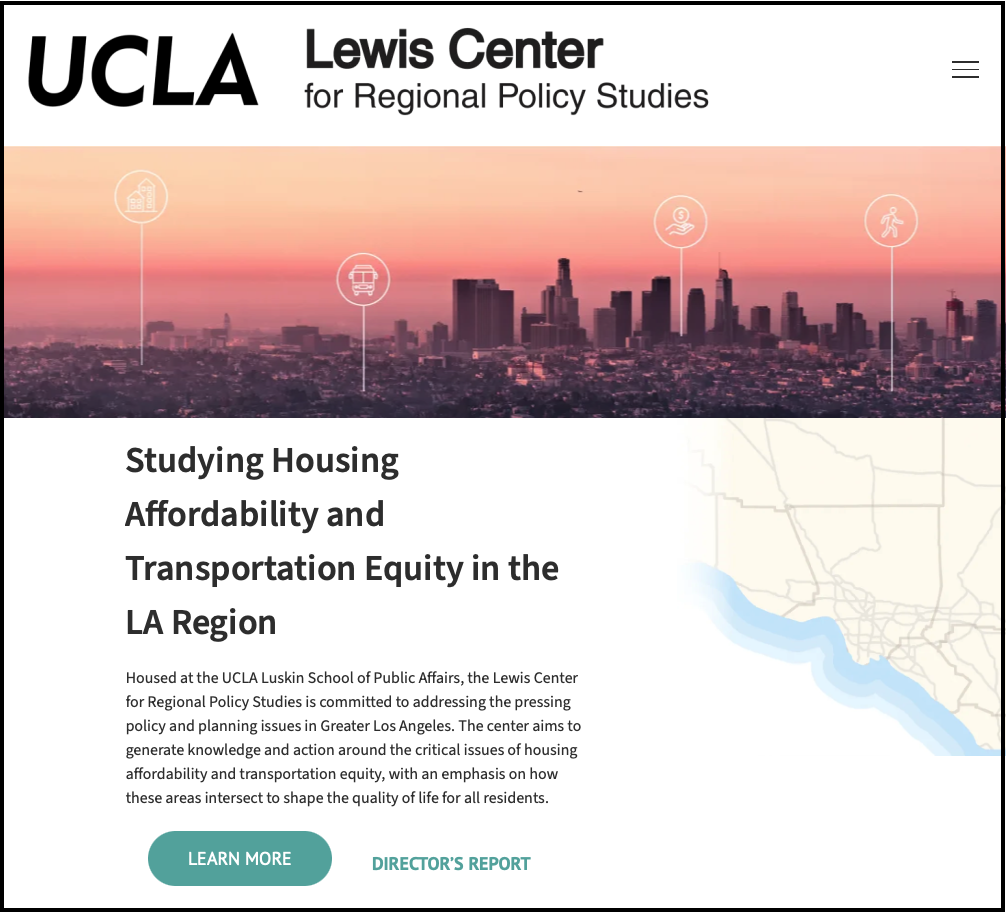
For Westchester-Playa residents, this new study from the UCLA Lewis Center for Regional Policy delivers several surprises:
A large majority of Angelenos (86%) want more apartments, even on single-family streets. In CD11, 46% of our neighbors support more multi-family development in our area.
Locally, you’ll sometimes hear neighbors report (with confidence) that “no one” wants more multi-family housing in Westchester-Playa. Or—taking a slightly softer approach—they understand that LA needs housing, but claim CD11 is being targeted unfairly, getting “too much” or “more than our fair share” of new development.
This UCLA study paints a very different picture.
Its findings validate Building a Better Westchester’s founding inspiration. We sensed there were more pro-housing residents in our area than the public dialogue would lead a neighbor to believe. And pro-housing neighbors deserved a place to share information and voice opinions on local land use issues.
The Survey Structure
Since 2016, the Lewis Center has conducted an annual survey to determine a Quality of Life Index for Los Angeles. The Center typically asks a range of questions about public safety, ethnic and race relations, transportation, traffic, etc.
All questions are answered with a strength of support rating, from 1 (strongly support) to 4 (strongly oppose) or 5 for “Do not know.”
The most recent study included a question specifically about new multi-family development.
27. I am going to mention some locations where new apartment buildings could be built to make housing more available. For each one, please tell me if you would support or oppose new apartments being built there:
- In your neighborhood
- On streets that primarily have single-family houses
- Streets that have primarily retail stores, office buildings or other commercial uses.
- Streets that primarily have apartment or condominium buildings. (asked of one half of respondents) OR
- Streets that primarily have apartment or condominium buildings, allowing taller buildings there with more housing units. (asked of the other half)
Surprising Results
-
46% of CD11 responders supported new apartments in their neighborhood.
-
54% of CD11 responders supported developing apartments on single family streets.
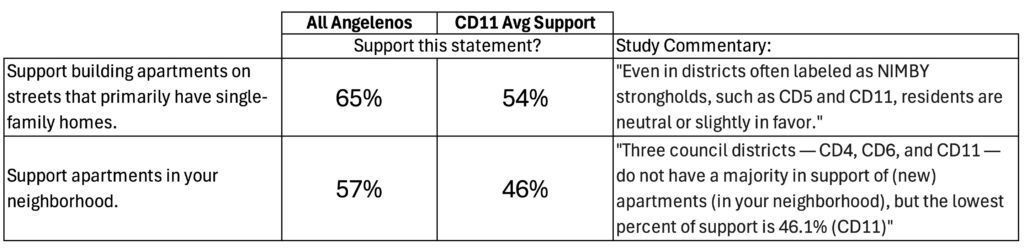
Locals who attend Westchester-Playa Neighborhood Council meetings or follow NextDoor might well find these numbers unbelievable. (Where are these people?) The science of polling suggests that they exist, but are not represented in Westchester-Playa’s public discourse.
Are These Findings Valid? Scientific Polling vs a Minority Dominating the Conversation.
The Lewis Center study took a scientific polling approach. To confirm survey interview targets, they used random dialing plus online probability sampling (common in social sciences research). As a result, they interviewed a demographically balanced sampling of LA’s different resident constituencies across the entire city.
To put this in local context, our own recent election seated new Neighborhood Council board members based on well under 100 total ballots cast. Our Neighborhood Council “represents” 75,000 residents. Statistically speaking, our Neighborhood Council’s tiny, self-selected sample is simply not representative of our diverse community.
Why Does This Matter? Policy Outcomes.
The Lewis Center Study author has this warning: politicians who support housing policy based on pleasing their noisiest constituents do not represent their entire community. Pollsters call this selection bias. Such bias is likely to deliver flawed outcomes that harm the common good: “Selection bias can become embedded in policy when decisions are based on systematically flawed or unrepresentative data, leading to policies that are ineffective or even harmful to the very populations they are meant to serve.” **
** Google. (2025, September 3). Gemini 2.5 [Large language model.] Search terms: “selection bias becomes policy.”